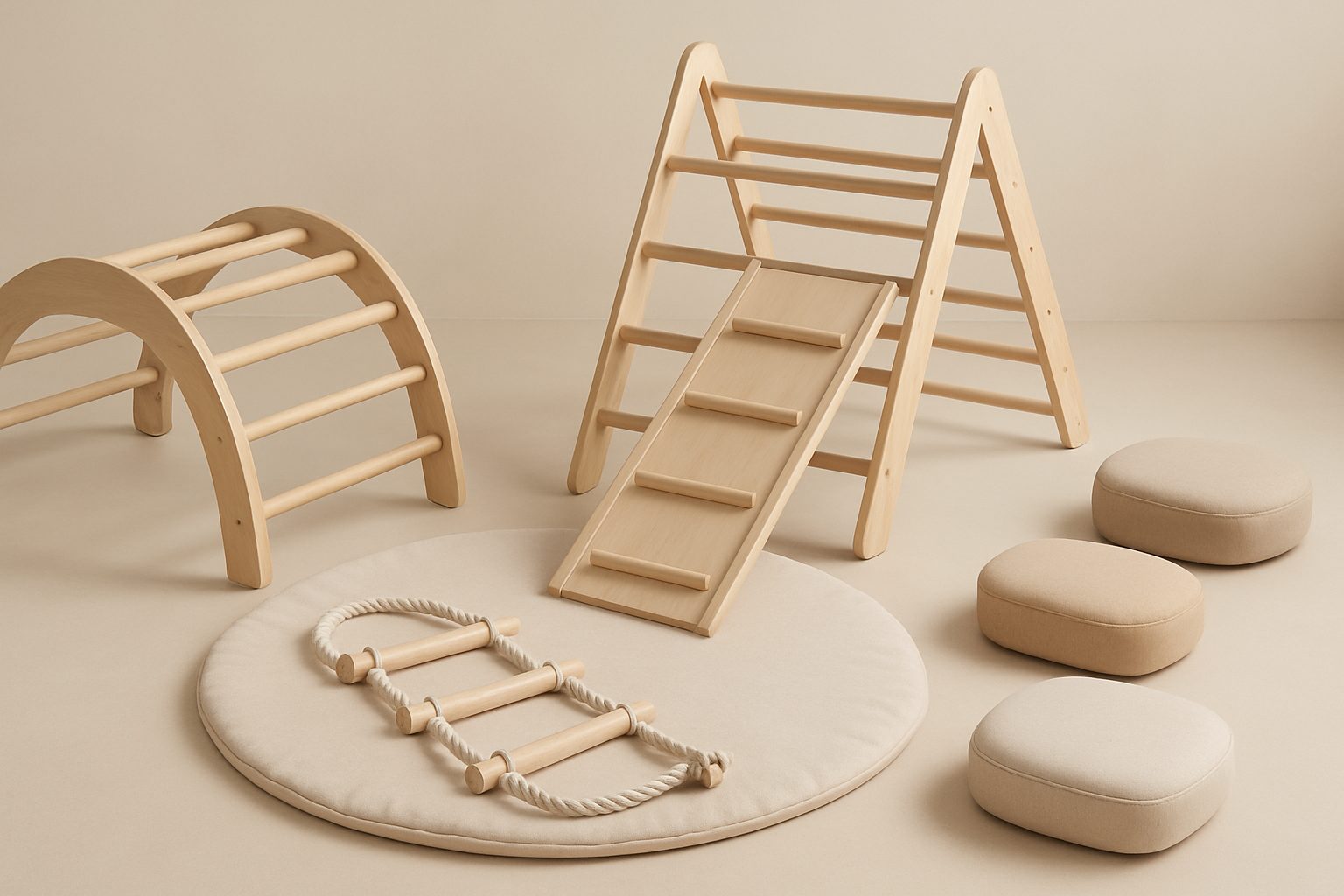
How to Choose an Indoor Climbing Frame in the UK: Complete Parent's Checklist
Indoor climbing frames have shifted from luxury toys to genuinely useful furniture for homes with active children. But choosing the right one — or deciding whether you need one at all — requires thinking through several practical factors. This guide walks you through the key decisions, so you end up with a frame that actually gets used and doesn't become an expensive obstacle course in your spare room.
Start with Space: Measure Before You Buy
This is the decision that rules everything else out. Climbing frames require floor space, height clearance, and ideally some buffer around them for safe play.
Measure your intended location carefully. Most compact indoor frames occupy 1.5m × 1.5m of floor space; larger A-frame designs can go to 2m × 2m or beyond. But don't just check the footprint — measure ceiling height from the floor to any light fittings, beams, or loft hatches. Most frames need 2.1m to 2.4m of clear space above them, depending on the design. If you're considering a loft room or sloped ceiling, you'll lose usable height quickly.
Look at how the frame sits relative to walls, furniture, and doorways. Your child needs enough open space around the structure to move safely, land if they jump, and avoid cracking their skull on adjacent furniture during enthusiastic play. Roughly a 0.5m buffer all around is sensible, though larger is better.
If space is tight, an A-frame ladder or smaller gym-style unit might work where a full climbing structure wouldn't. Be honest about this constraint upfront — it's the most common reason frames end up unused or dangerous.
Match the Frame to Your Child's Age and Ability
Climbing frames aren't one-size-fits-all. A structure that's engaging for a five-year-old becomes babyish for an eight-year-old, and something designed for older children can be genuinely unsafe for toddlers.
For children aged 2–4, look for lower frames (under 1.2m) with chunky handholds, wide steps, and enclosed sides. Frames in this range usually focus on climbing ladders, simple slides, and exploring movement in a bounded space. Safety is about containing them and preventing falls from height.
Children aged 5–7 typically want more challenge. They're developing real climbing ability and balance but still lack judgment about risk. Frames with varied climbing routes — nets, ropes, angled walls — keep them engaged without requiring adult supervision every moment. Heights of 1.5m to 2m are standard here.
Older children (8+) often prefer structures that let them climb higher and faster, with overhangs or rope elements. They'll also use frames differently — hanging upside down, creating games, testing their growing strength. If you have a range of ages at home, this becomes trickier; you may need to prioritise the oldest or look for modular designs that suit multiple ages.
Budget Realistically: Cheap vs. Built-to-Last
Climbing frames range from £100 for a basic plastic A-frame to over £1,000 for solid timber structures or modular gym-style systems.
Budget frames (£100–300) usually combine plastic or lightweight metal with minimal assembly. They're fine as a temporary solution or for very young children, but the plastic cracks, bolts loosen, and they often feel flimsy once a confident climber is using them regularly. If you're unsure whether your child will actually use it, starting here makes sense.
Mid-range frames (£300–700) typically use sturdy metal tubing or pressure-treated timber, with proper bolting and welded joints. These handle years of regular use. The climbing surfaces are more varied, and they feel stable under active children. This is where most family purchases land.
Premium options (£700+) include solid timber structures, modular systems you can expand, or specialist climbing walls. These are investments — they'll survive multiple children and potentially resale or hand-down value. They're worth considering if space is precious and you want one frame to work for years.
Factor in delivery and assembly costs, which can add £50–150. Some retailers offer assembly; others expect you to handle it. If DIY isn't your strong suit, paying for assembly is worth budgeting.
Material: Timber vs. Metal vs. Plastic
Each material has honest trade-offs.
Timber looks better in most homes, weathers naturally, and splinters are manageable with sanding and regular maintenance. It needs treating against rot if exposed to moisture, and it can be heavier to move or reconfigure. It tends to cost more upfront but ages gracefully.
Metal tubing (usually galvanised steel) is tough, requires minimal maintenance, and handles intense use. It can be noisier to climb (metal clanks), harder underfoot if a child falls directly onto it, and visually harsher in a living space. It doesn't degrade but can rust if the coating is damaged.
Plastic components are common on budget frames — lightweight, colourful, low-maintenance. Plastic degrades under UV sunlight, cracks under stress, and doesn't feel as stable as solid materials. It's fine for indoor-only use and younger children but doesn't age well.
Most durable frames mix materials: timber or metal frame with plastic-coated handles and steps. This balances durability, safety, and feel.
Safety Standards and Certifications Matter
In the UK, climbing frames sold as children's products should meet EN 71 (safety of toys) and ideally ASTM F1487 (playground equipment). Look for these markings on product listings or contact the retailer to confirm.
Check whether the manufacturer specifies age ranges, weight limits, and required supervision. A frame marked for ages 3+ with a 50kg weight limit should be treated as having those limits. Ignoring them voids any safety assurance and is genuinely risky.
Also check installation requirements. Some frames must be bolted to walls or floors; others are freestanding. Wall-mounted options are safer if you have confident climbers, but renters often can't bolt to plasterboard without permission. Freestanding frames need stable, level ground — a wonky garage floor is a problem.
Installation, Maintenance, and Longevity
Don't underestimate assembly. Most frames require 2–4 hours of work, bolts need tightening regularly (monthly for the first few uses, then quarterly), and metal frames benefit from inspection for rust. Timber needs annual staining or treatment depending on your climate.
Budget time and modest costs for maintenance. A loose bolt or worn surface can turn a safe frame into a hazard quickly.
Choose Strategically
Start with your constraints: space available, budget range, and your child's age and confidence level. Then narrow on material and safety features. Measure twice, order once — returning a large frame is a hassle.
More options
- Indoor Climbing Frames – General UK (Amazon UK) (Amazon UK)
- Toddler & Baby Climbing Frames UK (Amazon UK) (Amazon UK)
- Wooden Indoor Climbing Frame & Play Gym (Amazon UK) (Amazon UK)
- Freestanding Kids Climbing Wall & Boulder Panel (Amazon UK) (Amazon UK)
- TP Toys & Plum Play Indoor Frames (Amazon UK) (Amazon UK)